Become Like a Child to Enter Heaven
The Snow QueenBecome Like a Child to Enter Heaven is the story's closing spiritual principle, linking Gerda's purity and faith during her search for Kay to the biblical words read at the children's homecoming. Its force lies in the ending's contrast: Gerda and Kay have grown into a woman and a man, yet they understand that the words concern a childlike quality that their ordeal has not taken from them.
Biblical Statement and Meaning
The principle is stated when Grandmother reads from the Bible after Gerda and Kay have returned to their little room: "Except ye become as little children, ye shall in no wise enter into the kingdom of God." The verse turns their homecoming into more than a return to familiar surroundings. They look into each other's eyes and understand the words, connecting what they have lived through with the religious teaching Grandmother reads aloud.
The scene holds adulthood and childhood together rather than treating them as opposites. The old clock still ticks, their little chairs remain, and the roses again bloom at the window; but the children have become a man and a woman. The story's closing principle therefore does not require them to remain physically young. Instead, the ending presents their ability to receive the verse with understanding as evidence that childlike faith and innocence can endure beyond childhood.
Innocence as Effective Power
The story gives the principle practical meaning before stating it. When Gerda reaches the Finland woman's home, the woman says that no greater power can be given to the girl: her strength consists in her own purity and innocence of heart. She points to what Gerda has already accomplished, including making her way through the world barefoot and compelling people and animals to serve her. Gerda's strength is not an advantage bestowed by a powerful protector; it is identified as something already present in her.
That claim is tested as Gerda approaches the Snow Queen's palace. Left without shoes or gloves in the ice-bound landscape, she runs toward a regiment of living snowflakes. She remembers their appearance through a burning-glass, but the guards now stand before her as real and dangerous creatures. Gerda repeats the Lord's Prayer; the breath from her mouth gathers into angelic figures, who grow into a legion and shatter the snowflake guards. Faith here is not merely a belief described by the story: it accompanies the action that lets Gerda continue toward Kay.
Childhood in the Journey
The teaching also draws force from the children's beginning. Gerda and Kay are poor neighbors, not siblings, but they love one another almost as much as if they were. Their shared garden consists of flower boxes bridged across a water-pipe between their garret windows, where they sit beneath the roses or look at one another through holes melted in the frozen panes. The final return to their room and its roses restores the domestic setting in which their friendship first took shape.
Their journey puts that childhood affection under pressure. A fragment of the distorted looking-glass can affect a person's sight or heart, and Kay must be reached and freed from the glass fragments. Gerda leaves the conjuring garden when she realizes that its unchanging summer has concealed the passing of the seasons; she runs out barefoot and discovers that autumn has advanced. Her innocence is therefore not ignorance of every hardship. The journey exposes her to cold, danger, and loss, but her attachment to Kay keeps her moving through them.
Other children also shape the rescue. The Robber-girl, who sleeps with a knife beside her, chooses to free the Reindeer and send Gerda onward to the Snow Queen's castle. The episode places a child's forceful, unruly independence alongside Gerda's tenderness and persistence: aid comes not only from adults or supernatural beings, but from a child who decides to help another child.
Return and Lasting Significance
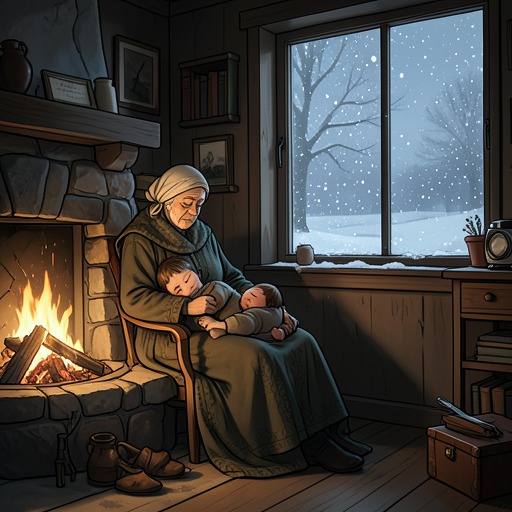
At home, the outward signs of childhood are still present, but time has changed the travelers. Gerda and Kay sit in their own small chairs and hold hands; as spring returns and the roses bloom at the window, the cold, empty grandeur of the Snow Queen's palace fades from their memories like a painful dream. Their understanding of Grandmother's verse makes the final return both physical and spiritual: they are home, and they recognize what has sustained them through separation and danger.
The old song they recall joins the roses' recurring bloom and fading with the promise of seeing the Christ-child. Its place beside the biblical verse makes the story's conclusion turn on the same contrast: earthly things pass, while faith offers a different horizon. Become Like a Child to Enter Heaven thus names the story's resolution, not as a reward for remaining untouched by experience, but as the persistence of innocence and trust through an experience that might have hardened or divided the children.